How to Turn a Rough Idea Into a Hook
A hook does not usually show up perfect. Most of the time it starts as a rough idea, a feeling, a phrase, or one line that keeps coming back. The job is to shape that raw thought into something people can repeat after the beat stops.
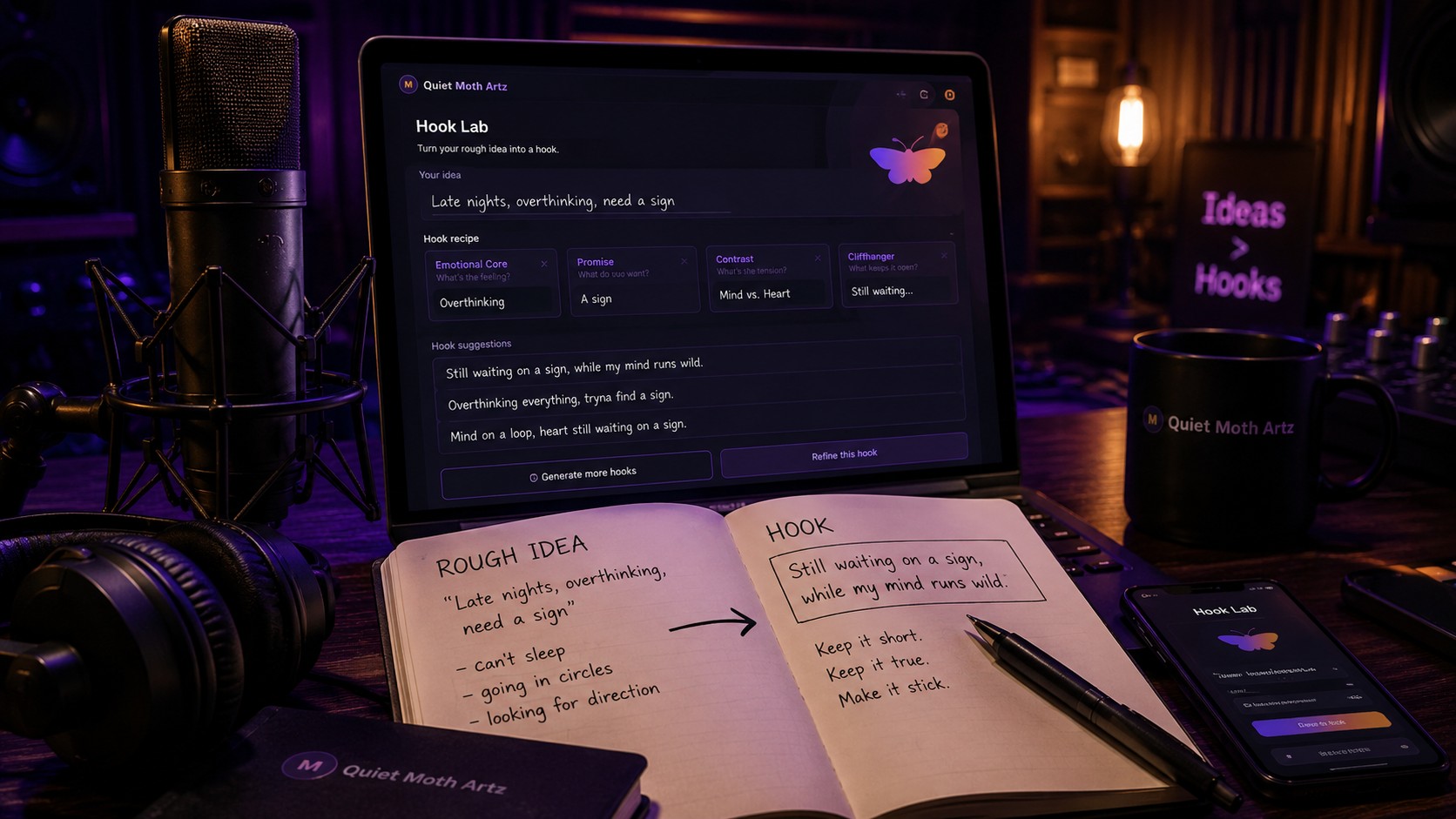
Start with the feeling, not the perfect line
A strong song hook usually has an emotion underneath it. Pain, confidence, love, pressure, celebration, warning, hunger, peace — something has to be driving the words.
Before trying to write the perfect chorus, ask what the idea is really carrying.
Is it about missing somebody? Proving people wrong? Trying to stay focused? Surviving something? Wanting more? Protecting your peace?
Once the feeling is clear, the hook has somewhere to go.
Find the phrase that wants to repeat
A hook needs a line people can hold onto.
That line does not have to be complicated. Sometimes the strongest song hook is the clearest phrase in the room.
If the idea is "I made it through hard times," the hook might center around:
- I made it through the rain
- Still standing after all that
- Built from what tried to break me
- I turned the pain into motion
The phrase should feel like the center of the song. Everything else can orbit around it.
Make the hook easy to say out loud
A hook lives in the mouth, not just on the page.
If the line looks good written down but feels awkward when spoken or rapped, it needs work. Say it out loud. Tap the rhythm. Hear where your breath lands.
Good hook writing usually has:
- simple phrasing
- clean rhythm
- strong ending words
- a line that can repeat without feeling forced
- space for melody or cadence
The goal is not to sound complicated. The goal is to stick.
Use repetition without getting lazy
Repetition is part of hook writing, but it has to earn its place.
Repeating the same phrase can work if the emotion grows each time. Repeating without movement can make the hook feel unfinished.
A simple structure can help:
- Line 1: say the main idea
- Line 2: add image or emotion
- Line 3: twist or raise the pressure
- Line 4: land the phrase harder
That gives the hook shape instead of just looping words.
Keep the hook connected to the topic
A lot of songwriting hooks fail because they drift away from the idea. The verse might be about one thing, but the hook starts sounding like a random quote.
If the song is about a new car, the hook should probably have motion, keys, roads, headlights, or freedom in it. If it is about heartbreak, the hook should carry distance, silence, memory, or loss. If it is about ambition, the hook should feel like climbing, pressure, proof, or hunger.
The listener should know what world the song is in.
A four-bar hook preview is enough to test the idea
You do not always need to write the full chorus first. Sometimes four strong bars are enough to test the direction.
A four-bar hook preview can show:
- the main phrase
- the rhyme direction
- the emotion
- the cadence
- whether the idea has life
That is why the Quiet Moth Hook Lab starts with four bars. It gives the idea a shape without giving away the whole song.
Turn the rough idea into a stronger hook
Once you have the first version, sharpen it.
Ask:
- Is the topic clear?
- Does the hook match the feeling?
- Do the last words rhyme or connect?
- Is there one line people would remember?
- Can this be sung, rapped, or chanted?
- Does it make somebody want the next part?
A hook does not need to say everything. It needs to make people want to hear more. That is true for rap hook writing, a hip hop hook, an R&B hook, a chant, a custom song hook, or a full chorus writing session.
The point is memory
A good hook gives the listener something to carry.
It might be a phrase, a melody, a warning, a flex, a confession, or a feeling. But when the music stops, something should still be in their head.
That is the real job of a hook. If you are learning how to write a hook, start there before trying to decorate it.
Need a hook built around your exact idea?
Quiet Moth Artz can help shape a four-bar hook preview, full 8-bar chorus, slogan, chant, or song idea around the message, mood, and audience you are trying to reach.